DFG Project 492813820 2023 – 2027 Life Sciences IR

Unlocking Preprint Knowledge in Life Sciences

PIXLS (Preprint Information eXtraction for Life Sciences) is an interdisciplinary research project by TH Köln and ZB MED. We bridge the gap between rapidly expanding preprint archives and deep machine readability through large-scale acquisition, Vision-Language Model extraction, synthetic relevance benchmarking, and practical discovery integration with LIVIVO.

530,000+ Preprints continuously acquired across 30+ servers
LIVIVO Discovery integration & practical RAG (livivo.de →)
Multimodal Deep parsing of tables, figures, captions & context
Core Mission 2023 – 2027

From Unstructured PDFs to Actionable Science

Life science preprints provide vital research insights long before formal peer review. PIXLS liberates critical knowledge buried inside PDF tables, formulas, and diagrams, making it FAIR, structured, and semantically searchable for researchers worldwide.

Featured Release v0.1.2 on PyPI

REANIMATOR-VLM

Our completely rebuilt document parsing toolkit powered by Vision-Language Models (dots.mocr) for multi-modal element extraction and domain-independent synthetic relevance assessment.

View on PyPI → pixls-preprints →
Search & Discovery ZB MED Portal

LIVIVO Life Science Search

Seamlessly integrating enriched preprint metadata and exploratory generative retrieval into LIVIVO, Germany's interdisciplinary discovery engine for medicine and life sciences.

The PIXLS Project & Scope

Preprint servers have transformed scientific communication in the life sciences, enabling immediate dissemination of groundbreaking results. However, traditional digital library systems struggle to index the rich multimodality of preprints.

The Challenge: Extracting Multimodal Structures from Scientific Literature

Scientific literature in biomedicine is inherently multimodal: the most essential experimental data, dosage tables, statistical results, and molecular observations are embedded within tables, figures, and visual layouts. Standard full-text search engines treat PDFs as flat strings of text, completely losing structural context and rendering tables and figures invisible to retrieval algorithms.

Furthermore, evaluating retrieval systems on new tasks requires costly human relevance judgments. Test collections age quickly, failing to reflect modern user requirements such as complex question-answering and Retrieval-Augmented Generation (RAG).

The PIXLS Solution: Multimodal AI & Open Science

Funded by the Deutsche Forschungsgemeinschaft (DFG) in the LIS program (Wissenschaftliche Literaturversorgungs- und Informationssysteme), PIXLS tackles both dimensions:

  • ✓ Automated Ingestion Pipeline: Continuous harvesting of 530,000+ preprints from bioRxiv, medRxiv, and 30+ OSF archives using pixls-preprints.
  • ✓ Vision-Language Parsing: Moving beyond brittle legacy rule-based tools to Docling and modern Vision-Language Models (dots.mocr) with reanimator-vlm.
  • ✓ Synthetic Relevance Benchmarks: Generating validated multimodal relevance labels using LLMs (UMBRELA framework) to revive legacy test collections (TREC-COVID+).
  • ✓ Preprint RAG Demonstrator & LIVIVO: The ZB MED team has engineered a usable RAG demonstrator connecting preprint intelligence with LIVIVO, while the CIR team at TH Köln focused on advancing deep multimodal information extraction.

Modular Research Architecture

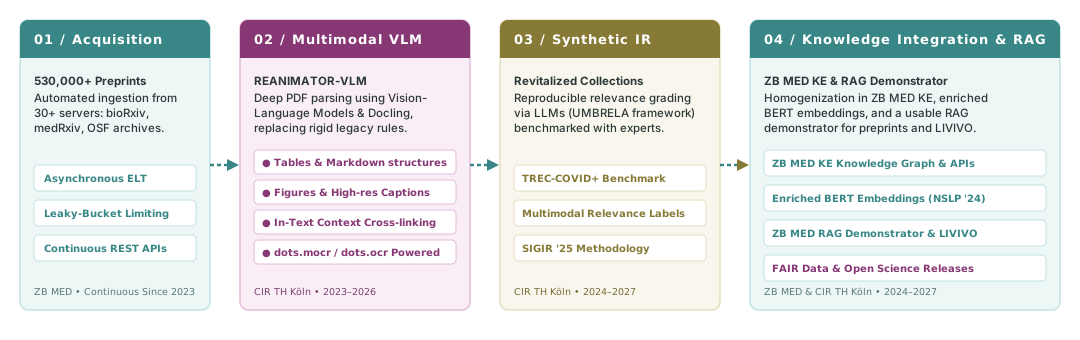
PIXLS System Architecture: Acquisition, Multimodal Extraction, Synthetic IR, and Knowledge Integration

Figure 1: Modular data flow from multi-source preprint harvesting through VLM parsing and synthetic test collection revitalization to ZB MED Knowledge Environment and LIVIVO integration.

Research Pillars

PIXLS structures its innovations across four collaborative pillars uniting the information retrieval expertise of TH Köln with the life sciences infrastructure of ZB MED.

Data Ingestion Since 2023

An asynchronous, fault-tolerant ELT pipeline that continuously harvests preprints and structured metadata from over 30 international repositories using REST APIs with leaky-bucket rate limiting.

Multimodal Extraction 2023 – 2026

Deep multimodal document parsing of scientific PDFs using Docling and Vision-Language Models (VLMs), extracting structured text, machine-readable tables, figures, captions, and in-text references.

  • Powered by reanimator-vlm (GitHub)
  • In-text reference contextualization
  • Structured relational storage
  • Independent of closed LLM APIs
LIVIVO & Knowledge KE 2024 – 2027

Homogenization and persistent enrichment of preprint metadata in the ZB MED Knowledge Environment (KE), combined with semantically enriched BERT embeddings for discovery.

Synthetic IR & RAG 2024 – 2027

Revitalizing test collections using LLMs/VLMs for synthetic relevance judgments, demonstrating the empirical impact of tables on scientific RAG, and engineering usable RAG demonstrators for Preprints and LIVIVO.

  • ACM SIGIR 2025 accepted framework (Preprint)
  • TREC-COVID+ multimodal benchmark
  • ZB MED RAG demonstrator for Preprints & LIVIVO
  • CIR team focus on high-fidelity extraction

Software & Open Source Tools

PIXLS embraces Open Science. Explore our modular open-source software stack for automated acquisition, VLM document extraction, and digital library integration.

Publications & Dissemination

Peer-reviewed articles, conference proceedings, and benchmarks directly originating from or closely aligned with the PIXLS project scope, sorted chronologically.

SEASON 2026 Poster March 16–18, 2026 • Cologne, Germany REANIMATOR Sample Case

Revealing the Hidden Success Factors of Scientific Papers: Structural, Linguistic, and Multimodal Dynamics

Fabian Haak and Philipp Schaer

Poster presented at the Conference on Search Engines and Society (SEASON 2026), Cologne, Germany. DOI: 10.6084/m9.figshare.34912698

Large-scale empirical meta-science study parsing 7,676 bioRxiv preprints with REANIMATOR to identify multimodal, structural, and linguistic drivers of peer-reviewed publication conversion and venue prestige. Detailed findings are discussed in our Project Blog.
@misc{haak2026revealing, author = {Haak, Fabian and Schaer, Philipp}, title = {Revealing the Hidden Success Factors of Scientific Papers: Structural, Linguistic, and Multimodal Dynamics}, howpublished = {Poster presented at Search Engines and Society (SEASON 2026), Cologne, Germany}, year = {2026}, doi = {10.6084/m9.figshare.34912698}, url = {https://doi.org/10.6084/m9.figshare.34912698} }
ACM SIGIR 2025 July 13–18, 2025 • Padua, Italy Core PIXLS Framework

REANIMATOR: Reanimate Retrieval Test Collections with Extracted and Synthetic Resources

Björn Engelmann, Fabian Haak, Philipp Schaer, Mani Erfanian Abdoust, Linus Netze, and Meik Bittkowski

In Proceedings of the 48th International ACM SIGIR Conference on Research and Development in Information Retrieval (SIGIR '25). ACM, New York, NY, USA, 11 pages. DOI: 10.1145/3726302.3730342

Introduces the REANIMATOR framework for automated multimodal extraction (tables, in-text citation links) and synthetic LLM relevance assessment (UMBRELA), establishing the revitalized TREC-COVID+ benchmark for multimodal RAG.
@inproceedings{engelmann2025reanimator, author = {Engelmann, Bj{\"o}rn and Haak, Fabian and Schaer, Philipp and Abdoust, Mani Erfanian and Netze, Linus and Bittkowski, Meik}, title = {REANIMATOR: Reanimate Retrieval Test Collections with Extracted and Synthetic Resources}, booktitle = {Proceedings of the 48th International ACM SIGIR Conference on Research and Development in Information Retrieval (SIGIR '25)}, year = {2025}, doi = {10.1145/3726302.3730342}, url = {https://arxiv.org/abs/2504.07584} }

Project Updates & Blog

Chronological dispatches, publications, tool releases, and milestone achievements from the PIXLS research team.

Empirical Sample Case March 2026

Poster at SEASON 2026: Revealing Hidden Success Factors of Scientific Papers with REANIMATOR

At Search Engines and Society (SEASON 2026) in Cologne, Fabian Haak and Philipp Schaer present an empirical study investigating structural, linguistic, and multimodal determinants of scholarly paper success—serving as a direct real-world demonstration of the REANIMATOR parsing toolkit.

By leveraging REANIMATOR's automated document extraction pipeline, the study parsed thousands of scientific full-text PDFs to extract tables, figures, captions, and contextually linked in-text references alongside textual linguistic metrics.

Core Empirical Takeaways:

  • Prioritize Visuals: Papers that feature figures and describe them thoroughly in both the caption and running text achieve higher visibility. Crucially, placing an early visual on page 1 or 2 correlates strongly with citation success.
  • Author Voice: Using an active first-person voice ("we") outperforms passive constructions. While complex domain language is well tolerated, authors should avoid empty intensifiers and synonyms.
  • Focus on Results: Overly lengthy, dense methodology sections often deter engagement; focusing on clear empirical outcomes yields higher scholarly traction.
  • Insignificant Elements: Factors such as Latinate nominalizations, table caption length, abstract sentence length, and punctuation marks (exclamations, parentheses) showed negligible statistical significance.

This work showcases how PIXLS multimodal parsing turns raw PDF archives into structured analytical corpora for meta-research and information retrieval. The full poster is openly published on Figshare at DOI: 10.6084/m9.figshare.34912698.

Software Release January 2026

Introducing REANIMATOR-VLM: Rebuilding Document Extraction with Vision-Language Models

We announced the release of reanimator-vlm (v0.1.2) on PyPI. This clean rebuild transitions the REANIMATOR extraction core from traditional OCR heuristics to state-of-the-art Vision-Language Models (dots.mocr) and Docling.

Extracting information from scientific PDFs has historically been hindered by brittle layout parsers and closed LLM dependencies. reanimator-vlm solves this by providing:

  • VLM Layout & Table Recognition: High-accuracy parsing of complex biomedical tables, sub-tables, formulas, and visual elements.
  • In-Text Contextualization: Automatic linking of table and figure mentions in the narrative text to their corresponding visual containers.
  • Synthetic Relevance Engine: Domain-independent relevance assessment based on the UMBRELA framework for evaluating RAG and retrieval benchmarks.

Install today via pip install reanimator-vlm or inspect the open-source code on GitHub.

PyPI Package →
Open Infrastructure November 2024

Codeberg Releases: pixls-preprints Harvester & livivo-converter Schema Tool

To support open scientific infrastructure and reproducible data pipelines, ZB MED and TH Köln have released our acquisition and transformation repositories on Codeberg.

The pixls-preprints toolkit powers the daily harvesting of 30+ preprint archives, utilizing asynchronous REST APIs and leaky-bucket algorithms to respect rate limits while maintaining high ingestion throughput.

The companion tool, livivo-converter, handles schema transformation, mapping heterogeneous metadata from preprint platforms into normalized records ready for ingestion into ZB MED's LIVIVO search portal.

Codeberg →
Workshop Paper May 2024

Enriched BERT Embeddings for Scholarly Publication Classification at NSLP 2024

Benjamin Wolff, Eva Seidlmayer, and Konrad Förstner presented new findings on enriching BERT embeddings with domain metadata at the Natural Scientific Language Processing and Research Knowledge Graphs workshop (NSLP 2024).

Published in Springer CCIS, this work explores how combining contextual language representations with curated structured metadata from the ZB MED Knowledge Environment enhances text classification accuracy, laying the groundwork for automated preprint subject indexing.

Springer →
Kick-Off January 2023

PIXLS Research Project Officially Launched (DFG LIS Grant #492813820)

The Deutsche Forschungsgemeinschaft (DFG) has officially funded the joint project "Preprint Information eXtraction for Life Sciences" (PIXLS) by TH Köln (CIR) and ZB MED under the Scientific Library Services and Information Systems (LIS) program.

Led by Prof. Dr. Philipp Schaer (TH Köln) and Prof. Dr. Konrad U. Förstner (ZB MED), PIXLS aims to make rapidly published preprint literature methodically accessible, extracting tables, formulas, and figures, and establishing next-generation retrieval services for the German and international research communities.

DFG GEPRIS →

Community Workshop

Fostering exchange between research and infrastructure practice across German and international digital libraries.

ISI 2027 • Hamburg

Information Extraction in Practice

Information extraction (IE) has transitioned from research prototypes into everyday practice across libraries, archives, and research data services. While LLMs and VLMs have dramatically lowered entry barriers, deploying robust pipelines in production raises vital questions about quality assurance, data provenance, computational cost, and long-term service sustainability.

Co-organized by leaders from TH Köln, ZB MED, ZBW, and GESIS, this half-day workshop brings together practitioners and researchers from the DFG LIS programme, Leibniz institutes, and NFDI consortia to seed a sustainable community of practice.

Tentative Timeline (ISI 2027)

  • Call for Contributions: 14.12.2026
  • Submission Deadline: 25.01.2027
  • Author Notification: 08.02.2027
  • Camera-Ready Abstract: 22.02.2027
  • Workshop Venue: Hamburg, Germany
Outcomes: Joint synthesis report in Datenbank-Spektrum (Springer) and a curated open list of IE tools & datasets.

Topics of Interest

Pipelines & Multimodal Parsing
  • Extraction from OCR output, historical PDFs, tables, and figures
  • LLM- and VLM-based extraction in production: prompting, fine-tuning, and hallucination control
  • Entity linking to authority files and knowledge graphs (GND, Wikidata, ORKG)
Evaluation, QA & Provenance
  • Evaluation methodologies, gold standards, and benchmark datasets
  • Human-in-the-loop workflows for subject experts and cataloguers
  • FAIR publication, data provenance, and transparency of extracted metadata
Infrastructure & Sustainability
  • Moving IE components from funded DFG/NFDI projects into permanent library services
  • Operational cost, latency, and hardware constraints in production
  • Legal and ethical aspects under German text and data mining copyright law

Workshop Organizers

Prof. Dr. Philipp Schaer

Professor for Information Retrieval

TH Köln

Prof. Dr. Konrad U. Förstner

Head of Data Science & Services

ZB MED / TH Köln

Prof. Dr. Ralf Krestel

Information Profiling & Retrieval

ZBW & CAU Kiel

Dr. Benjamin Zapilko

Team Lead Information Extraction & Linking

GESIS Leibniz Institute

Participating Institutes & Team

PIXLS combines the information retrieval expertise of TH Köln with the life sciences infrastructure and data science capabilities of ZB MED.

TH Köln

Cologne Information Retrieval Group (CIR)

CIR Emblem TH Köln Emblem
Team Website: ir.web.th-koeln.de →

Prof. Dr. Philipp Schaer

Principal Investigator (Project Lead)

Fabian Haak, M.Sc.

Research Associate & Doctoral Researcher

ZB MED

Information Centre for Life Sciences

ZB MED Emblem

Prof. Dr. Konrad U. Förstner

Principal Investigator (Project Lead)

Benjamin Wolff, M.Sc.

Research Associate

Gefördert durch die Deutsche Forschungsgemeinschaft (DFG)

DFG Funding & Project Metadata

This project is funded by the Deutsche Forschungsgemeinschaft (German Research Foundation) within the funding program "Scientific Library Services and Information Systems" (LIS).

Official Title Preprint Information eXtraction for Life Sciences (PIXLS)
DFG Project Number 492813820 (GEPRIS Entry →)
Program Scientific Library Services and Information Systems (LIS)
Applicants Prof. Dr. Philipp Schaer (TH Köln), Prof. Dr. Konrad U. Förstner (ZB MED)
Project Period 01.01.2023 – 2027
FAIR & Open Science Open Source Toolkits (MIT), Open Access preprints, CC-BY Dissemination